
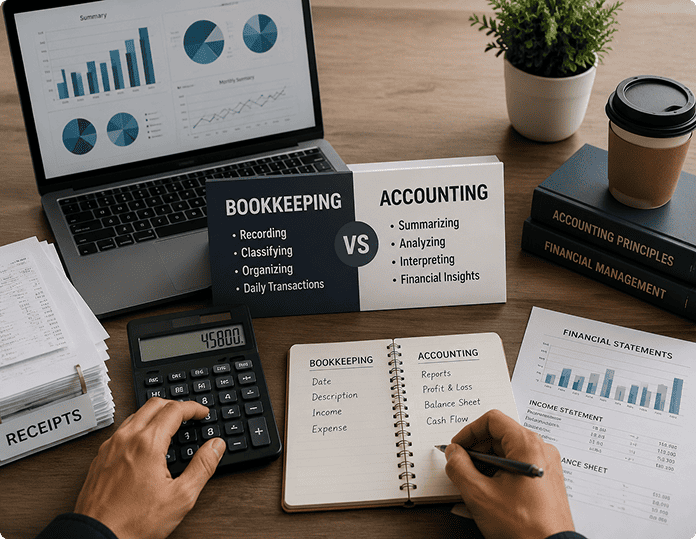
Many people use the terms bookkeeping and accounting as if they mean the same thing. While they’re closely connected, they aren’t the same. Understanding the difference doesn’t require complicated definitions or accounting terminology. It simply starts with understanding what happens in a business every day.
Every sale, purchase, payment, invoice, or expense creates a business transaction. Those transactions need to be recorded before anyone can understand what the business is doing. That’s where bookkeeping begins. Accounting builds on those records, but without good bookkeeping, accounting has very little to work with.
It All Starts with Bookkeeping
Imagine running a small business.
- A customer pays an invoice.
- You purchase new equipment.
- You pay wages.
- You receive a supplier’s bill.
Each of these activities needs to be recorded accurately. Bookkeeping is the process of recording, organising, and maintaining those everyday business transactions so they become reliable business records.
Think of bookkeeping as building the foundation of a house. If the foundation isn’t solid, everything built on top of it becomes much harder to rely on.
So, What Does an Accountant Do?
Once business records have been maintained correctly, accounting uses that information to help interpret what it means. An accountant might:
- Review financial information
- Prepare financial statements for you
- Assist you with taxation
- Help businesses understand financial performance
- Provide advice to support your business decisions
Bookkeeping is simply the recording of what has happened. Accounting is the explanation of what those records mean.
Here’s a Simple Way to Look at It
Bookkeeping and accounting are two separate jobs, but it is often easier to think of them as two parts of the same process.
Bookkeeping
- Records every business transaction
- Organises journals and business records
- Maintains accurate financial information
- Creates the information needed later
Accounting
- Reviews organised business records
- Analyses financial information
- Prepares reports and financial statements
- Helps businesses understand their financial position
Both are important, but one naturally comes before the other.
Why Good Bookkeeping Matters
Many business owners only think about bookkeeping when it’s time to prepare tax returns or meet reporting requirements. In reality, however, bookkeeping plays an important role throughout the year. When business records are accurate and well organised, it becomes much easier to:
- Keep track of income and expenses
- Understand cash flow
- Monitor business performance
- Find information when it’s needed
- Work with accountants and advisers
- And, lastly, make better-informed business decisions
Bookkeeping Is Not Just Data Entry
One of the biggest flawed opinions is that bookkeeping is just entering numbers into a spreadsheet. The truth is that good bookkeeping is about understanding where the information goes, why it’s recorded and how individual transactions add up to a complete picture of a business.
Every transaction is a piece of the story of the business as a whole. Those transactions are reliable business records that, if properly recorded, can be understood, reviewed, and used with confidence.
Learn Bookkeeping Practically
For many people, bookkeeping seems difficult because they’re introduced to accounting terms before they understand everyday business transactions. A practical learning approach works differently.
Instead of memorising definitions, learners begin by working through realistic business activities. They learn how to:
- Record transactions
- Complete journals
- Organise business records
- Understand how information fits together
- Develop confidence through practice
As each activity builds on the previous one, bookkeeping starts to make sense naturally.
Where KYB Fits In
At Know Your Business (KYB), we believe bookkeeping is best understood by doing it. Our learning approach begins with everyday business transactions and gradually shows how those transactions become organised business records.
It doesn’t matter if you’re a student, teacher, entrepreneur or business owner. The idea is the same: to help you understand bookkeeping by practical experience, not just theory.
Endnote
Bookkeeping and accounting are two sides of the same coin, but they are not the same. Bookkeeping is the process of recording and classifying business transactions. Financial accounting uses these well-organized records to interpret financial information and help with better decision-making.
Understanding bookkeeping isn’t about learning complicated terminology; it’s about understanding how everyday business transactions become organised business records. That’s the first step towards understanding the business itself.
Ready to Learn Bookkeeping Through Practical Experience?
Explore the KYB CAIR Bookkeeping Products and discover a practical way to understand bookkeeping through realistic business activities, step-by-step learning, and organised business records.